
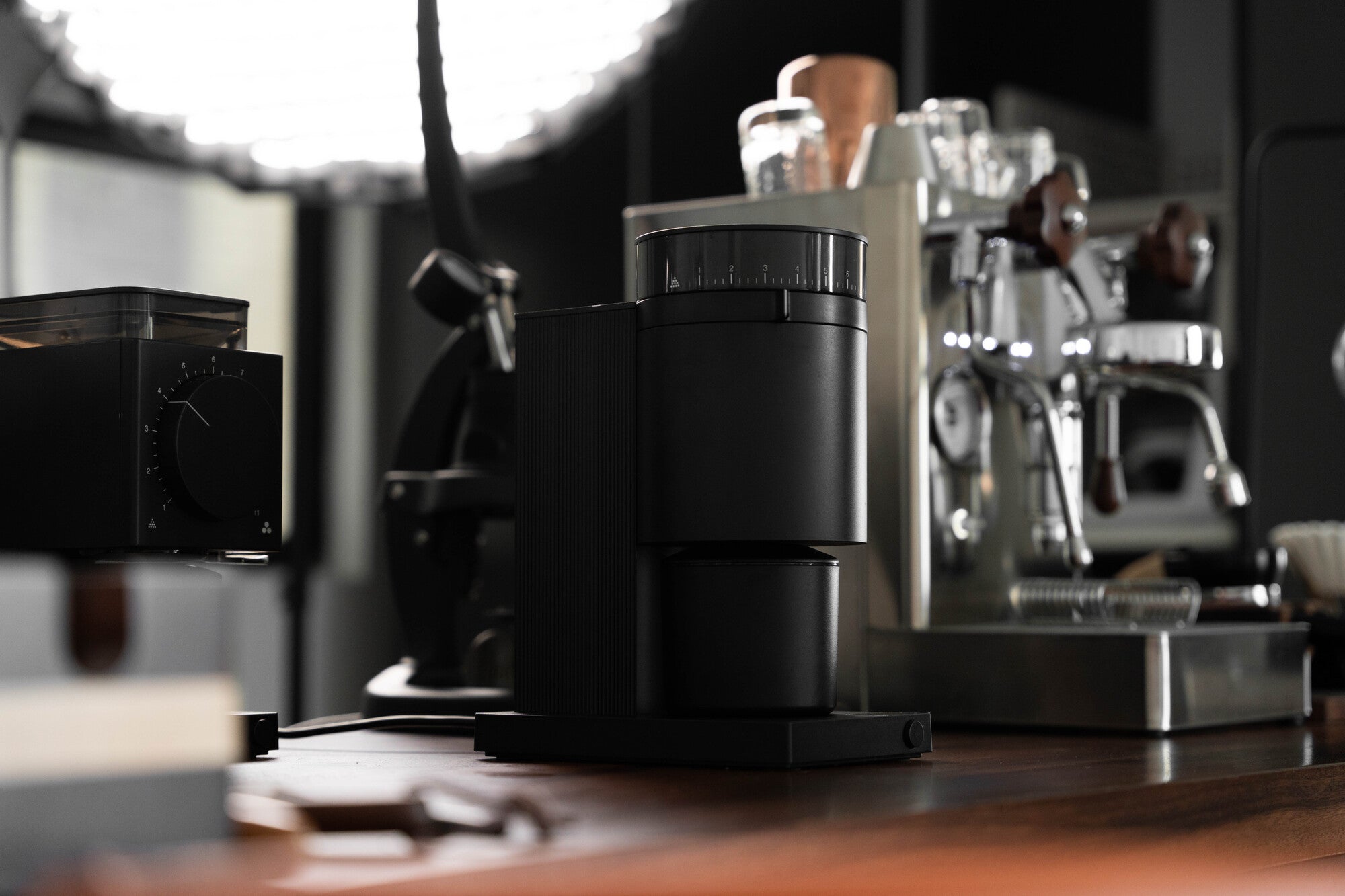
As I mentioned before, the choice of electric coffee grinders in the thousand-dollar price range is very limited. If you want to make espresso—leaving manual grinders aside for the moment—even electric grinders may sometimes jam on the beans and fail to grind them. When the Fellow OPUS was released, I thought the price was quite good, provided that you are certain you want to drink espresso. If you are only a pour-over coffee enthusiast, I would suggest buying an Ode Gen 2 directly or considering one of the good options from other brands.

Once I knew that this coffee grinder was priced at around HKD$1900, I thought its positioning was very aggressive and that it could produce very good coffee. Starting with pour-over, after testing it for around two weeks, I did not find the pour-over results particularly good because the grounds contained a great deal of fines and retained grounds, and the grind was not very even. By contrast, its espresso performance was good, so the results from this machine surprised me.

If I had to describe this experience simply, I would call it an electric coffee grinder that “firmly believes young people can overcome this problem”.


The plastic body is not too large, and its appearance is acceptable
Let us begin with its appearance. For most people, the plastic material of the outer casing is the greatest concern. In practice, I find the casing acceptable. It does not look as resin-like or plastic-like as we might imagine. If the light in your home is not very strong, I actually find that it looks little different from the metal grounds catch cup beneath the Fellow Ode grinder. You can only tell at very close range, so I do not think its appearance is as poor as we might expect.


The grind is less even when grinding beans for pour-over coffee
Next is the issue of grinding. If you genuinely intend to buy this as a pour-over grinder, I would advise choosing a manual grinder instead, looking at an electric grinder designed specifically for pour-over, or even moving up to a Fellow Ode grinder. I tried very hard to use it for pour-over and found the following three major issues. First, the grind is uneven; the inconsistency between coarse and fine particles is a bigger flaw than expected. Second, as a consequence of the first issue, it produces many fines—the coarser the grind, the more fines it produces.


As a result of the first and second issues, many fines become trapped around the burrs because of the grinder's straight-through design. Although the entire outer burr can be removed, which is extremely convenient, cleaning the inner conical burr is another matter. Because of the design, it is easy to remove but difficult to reinstall. If you decide to clean the inner burr, you will need to set aside an hour for cleaning and reassembly, together with some luck that the screw will fit precisely into the centre of the shaft.


The third issue is that it is impossible to remove all of the fines. If you want an exceptionally clean flavour from pour-over, you may find that small traces of other flavours sometimes become mixed in because the grinder is difficult to clean. Overall, however, it is still acceptable.
The overall espresso grind is noticeably more even
For espresso grind settings, I find its overall capability much stronger. As mentioned in the third point above, the amount of fines decreases as the grind becomes finer, although the third issue still remains. However, perhaps because I use it for milk-based coffee or Espresso, I find the result much more acceptable.


First, the grinder's motor is very powerful, and so far it has not jammed on any beans. Other grinders at the same price may occasionally jam. If that happens, congratulations—you will be rewarded with a long grinder-cleaning process. Compared with manually grinding for Espresso, using an electric coffee grinder is far more comfortable. At least you do not have to grind for 3–4 minutes every morning before you are finished.


Sometimes I also want to try other new beans, but adjusting the grind setting takes time. If I had to grind the beans with a manual grinder every time, the experience would be very poor because my hands tire easily. I once ground coffee ten times in one day, and my hands were almost exhausted. This grinder provides enough power to grind the beans and offers very good stability. Both qualities are essential for grinding to the fineness required for Espresso.


The grind is not excessively uneven, although there is a clear difference compared with pour-over. I have tried it with a Flair 58 and a Lelit Mara X, as shown in my IG Story. The final results were good and acceptable; it simply took some time at the beginning to find the right grind setting.

Another point is the noise produced while grinding coffee. The coffee grinder has enough power, so its sound insulation is slightly less effective and it is relatively loud while grinding. However, I found that in around 20–30 seconds, it could grind 18 grams of coffee for espresso. If it only means tolerating the noise for a short time, I find that acceptable.


The third point is grind retention, which I think is relatively common. I put about 18.5 grams of coffee into the grinder each time, and the final output is usually 17.8–18 grams. I have, of course, tried blowing the grounds out or gently tapping the machine, but it always retains some grounds. Would I say that this affects my experience? Personally, I find it acceptable. At least after grinding, it can genuinely produce coffee, and once the puck has been prepared, the coffee column also comes out steadily.


Fellow OPUS electric coffee grinder: conclusion
These are my results after using it for around two weeks, during which we drank 15–16 cups of coffee. I think this coffee grinder is suitable for beginners. If your budget is limited and you do not want to spend too much on a more advanced model, it is definitely a very good choice.
Some of the comments above may suggest that I am not very satisfied with this machine's performance, but I am comparing it with the Niche Zero, which costs 3–4 times as much. Overall, this coffee grinder at least completes most of the work. Grinders at different prices will, of course, produce different flavours, but at this price I think this machine is very much worth buying. Being able to buy an electric grinder for Espresso and pour-over at the HKD$1,900 price point genuinely offers very good value, and I am very willing to accept it.


If you have searched for the price of electric grinders for espresso, you will find that they cost at least HKD$3000 or more. This coffee grinder is now priced at close to half its original price, so I think it is worth trying. If you already own a more advanced grinder, there is, of course, no need to buy this one for experimentation. But if you want to try making espresso, this grinder offers an entry price that is not too expensive, and I believe it will become a good companion.

There is nothing else in particular for now. Finally, thank you to @songpo.hk and @fellow.taiwan for the invitation to collaborate. That concludes my honest and candid account for now. The end!
Hong Kong distributor website:Official Fellow & Origami Hong Kong website (song-po.com)
Coffee grinder: Fellow Opus conical-burr coffee grinder
Dimensions: 210mm x 192mm x 269mm
Suitable for: Espresso
Grinding range: <200 microns and above
Grind settings: 41 steps plus micro-adjustments
Burrs: 40mm conical burrs, six-point stainless-steel conical burr
Burr speed: 350 RPM
Anti-static technology: Supported
Bean hopper capacity: 110g
Brewing range: Espresso, AeroPress, pour-over, home coffee machines and French press
Cold brew and cupping.