

You may spend time adjusting grind size, water temperature and coffee-to-water ratio, and even switch drippers for different coffees, only to pour the finished brew into whichever cup is at hand. If the beans and brewing parameters stay the same, is the cup really just a container?
Pouring the same coffee into different cup shapes does not create new floral notes or sweetness. Yet the way the rim meets your lips, how the liquid enters your mouth, the distance between your nose and the surface, and the pace of cooling can all change how you experience that same coffee.
Choosing a cup is therefore not about finding a magical vessel that makes every coffee taste better. It begins with understanding what matters to you. By the end of this guide, you should be able to decide whether an everyday mug, thin-rimmed cup, pour-over tasting cup or aroma-focused cup best fits the way you drink coffee.
Choose a cup in 30 seconds: start with purpose, not brand
| Your main need | What to prioritise | A suitable cup type |
|---|---|---|
| Office use, large milk drinks and slow sipping | Capacity, handle, heat retention and durability | Large mug or insulated cup |
| Everyday home use and easy cleaning | Capacity, feel, dishwasher and microwave suitability | Everyday ceramic cup |
| Espresso or small tasting portions | Small capacity, heat retention and rim feel | Small coffee or tasting cup |
| A typical single-cup pour-over | Around 150–230ml, balancing rim feel with daily use | Ceramic or glass pour-over tasting cup |
| Comparing coffees, aromas and temperature changes | Opening, rim, aroma space and liquid level | Thin-rimmed or aroma-focused cup |
| Collecting, gifting or matching your home | Form, glaze, story and lead time | Handmade ceramic or design-led cup |
If you simply want a good, practical coffee cup, you do not need to master every theory of cup shape first. Capacity, where you will use it, and how you clean it will already rule out most unsuitable choices. Only after those basics fit is it worth comparing the opening, rim and aroma space.

Answer three questions before buying a cup
First: what do you drink, and how much at a time?
Capacity is the easiest factor to understand—and one of the easiest to get wrong.
- Around 60–90ml: espresso, small tasting portions or split-cup comparisons
- Around 150–230ml: a typical single-cup pour-over or specialty-coffee tasting
- Around 250–350ml: a larger everyday drink, milk coffee or brewing directly into the cup
A cup that is too small requires frequent decanting. If the cup is too large for the serving, the liquid sits much lower. These ranges are only a starting point; match them to the amount you actually brew.
Second: do you value convenience, rim feel, heat retention or aroma?
Different priorities lead to very different cups:
- For convenience and heat retention, begin with wall thickness, the handle, a lid and durability.
- For the drinking experience, compare rim thickness, the curve of the body and the direction of liquid flow.
- For aroma, consider the space at the opening, the liquid level and the distance between your nose and the coffee.
- For a stronger sense of craft, appearance, glaze, weight and handmade variation all affect whether you will want to use the cup every day.
Third: which trade-offs fit your routine?
Even a distinctive cup may remain in the cupboard if its care requirements do not fit your life.
Before buying, check:
- whether it is dishwasher- or microwave-safe
- whether the base and internal structure are easy to clean
- whether sudden temperature changes must be avoided
- whether the thin body requires extra care against impact
- whether you are willing to wait for made-to-order production
- how the brand handles shipping damage and structural defects
What kind of coffee drinker are you?
Everyday convenience
You mainly drink large coffees or milk drinks, often sipping while you work, and you value heat retention, durability and dishwasher use. A standard mug or insulated cup will usually suit you better than a specialised tasting cup.
Everyday pour-over
You normally brew around 150–230ml. You want a comfortable rim and the right capacity, but rarely divide the same coffee between cups for comparison. A well-sized ceramic or glass cup with no unwanted odour and a comfortable feel is usually enough.
Aroma exploration
You notice floral or fruit notes and processing methods on coffee bags, and compare how the same coffee changes from hot to cool. You are willing to split a brew between two cups and alternate between smelling and tasting. At that point, the opening, rim and aroma space begin to offer clearer value.
Craft and collecting
You care about glaze, feel, origin, the making story and the differences between individual pieces. Handmade ceramics can be rewarding to collect or give, but capacity and care restrictions should still come before appearance alone.

When is an ordinary coffee cup enough?
If you mainly need a cup that holds coffee, feels comfortable at the rim, cleans easily and suits your usual serving, an ordinary ceramic or glass cup of the right size is enough.
A specialised shape is not required for good coffee, and it cannot replace fresh beans, suitable grinding, clean water or consistent brewing.
If you have never wanted to compare the same coffee across different cups, and do not pay particular attention to aroma as the coffee cools, the answer is simple: choose a cup that fits your serving size, cleaning routine and everyday use.
When is an aroma-focused cup worth considering?
Some people encounter a different set of questions:
- The bag describes floral or fruity notes, but you find them difficult to detect.
- The coffee smells vivid when first poured, but halfway through the cup the aroma seems increasingly distant.
- You have begun comparing washed, natural and honey processes, or how a coffee performs at different temperatures.
- Your brewing is already consistent and you want to explore another variable in tasting.
- When drinking a more expensive or familiar coffee, you are willing to sit down and pay close attention.
Only when you begin noticing questions like these does an aroma-focused cup become more than an unusual shape. It does not change how coffee is brewed; it changes how aroma, liquid and your nose meet after brewing.
There is no single fixed shape for an aroma-focused cup. Different designs may use a wide or narrowed opening, internal curves, an indented rim or other structures to alter the relative positions of the liquid, your mouth and your nose.

What can cup shape change—and what can it not change?
A study involving 276 specialty-coffee drinkers and professionals found that cup shape affected participants’ ratings of aroma, sweetness, acidity and preference. Importantly, making a sensory characteristic more intense did not necessarily make the cup more popular with general participants.
UCC has also conducted sensory research using the same coffee in different cup shapes. It reported that shape, weight, tilt angle and the distance between the liquid surface and the nose may influence perception.
These studies support comparing cup shapes, but they do not prove that any specialised cup is always better, or that a stronger aroma is always more enjoyable.
Cup shape may change how a coffee is perceived. It cannot add flavours that were not already present, nor correct stale beans or inconsistent brewing.
Test with cups you already own before buying an aroma-focused cup
Rather than accepting any brand’s description of cup shape, first test whether the difference matters to you. Divide the same coffee between two differently shaped cups; the result will be more personal and useful than any product description.
- Choose a coffee you know well.
- After brewing, divide equal amounts between two cups.
- Keep the starting time and temperature of both cups as close as possible.
- Smell first, then alternate between the cups.
- Record aroma intensity, pleasantness, rim feel and changes as the coffee cools.
If you cannot detect a difference—or simply do not care about it—an ordinary cup is enough. If you notice a difference but want one cup for broad everyday use, consider a balanced shape. If you enjoy concentrating aroma, comparing coffees and observing temperature changes, an aroma-first design may be worth exploring.

If aroma matters to you, how far can cup design go?
At this point, the question is no longer “Which coffee cup is best?” It is whether closer observation of aroma is worth accepting a smaller capacity, hand-washing and more careful maintenance.
If not, an ordinary ceramic cup is enough. If it is, consider a practical design case: how Coffee Stage developed the idea of reducing the distance between nose and coffee through Sharing Cup Alpha and Beta.
The design process can be understood through two consecutive questions.
First question: while drinking, how can the nose move naturally closer to the inside of the cup?
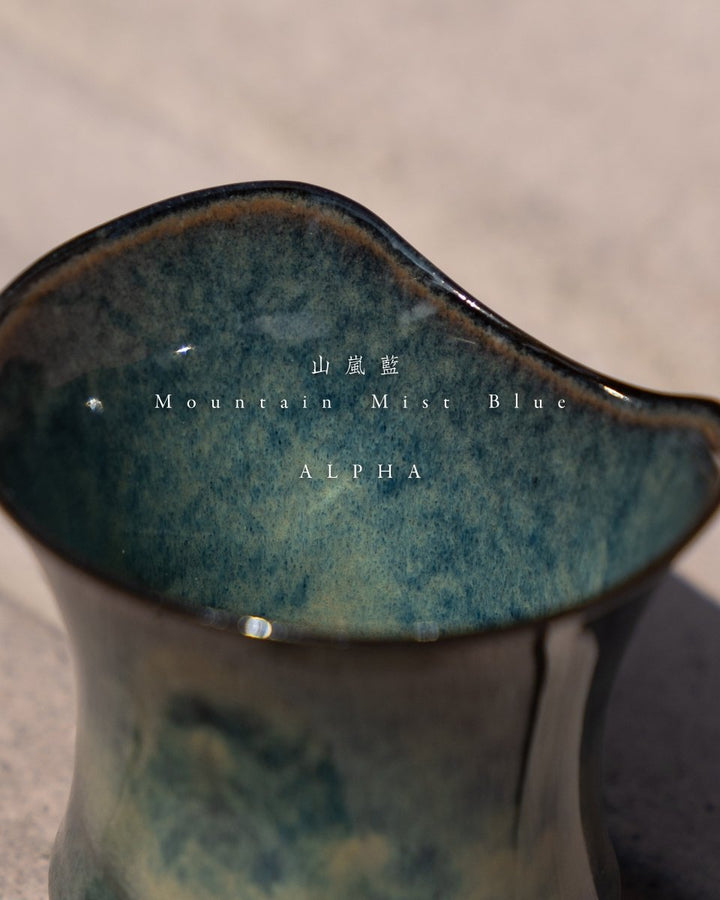
Coffee Stage first addressed this with the indented rim of Sharing Cup Alpha. Drinking from the indented side brings the nose closer to the interior without requiring a deliberate forward movement.
Alpha aims to balance aroma, flavour and everyday use.
Second question: what happens as the liquid level falls?
After using Alpha for about six months, the designer noticed that although the indented rim brought the nose closer to the cup, the liquid level still fell with every sip. Even when the nose remained near the rim, its distance from the coffee-wetted surface gradually increased.
Coffee Stage therefore asked whether part of the coffee-wetted surface could remain closer to the nose without adding removable parts or changing the normal act of drinking.
That question ultimately became the central aroma column in Sharing Cup Beta.
What does Sharing Cup Beta actually change?
Beta and Alpha share the same external dimensions. Within that form, Beta adds an integrated central aroma column approximately 5cm high and 2cm wide.
When a small amount of coffee touches the column, it can form a thinner layer over the three-dimensional surface. The design is intended to bring part of the wetted surface closer to the nose—not to create aromas that were absent from the coffee.
Because the central structure occupies space, Alpha holds approximately 230ml while Beta is rated at approximately 190ml. Pour-over users may see a reading close to 190g on a scale; that is a measurement of water, not the cup’s own weight or a recommendation to fill it to the rim every time.
As the cup tilts from nearly upright, the indented rim keeps the nose close to the interior while the column changes position relative to the drinker. The four angle illustrations show one continuous drinking motion, not four fixed poses.


Every design outcome involves a trade-off
| Design outcome | What it may offer | Trade-off to accept |
|---|---|---|
| Central three-dimensional surface | Brings part of the coffee-wetted surface closer to the nose | Capacity falls from approximately 230ml in Alpha to approximately 190ml in Beta |
| Indented rim | Allows the nose to move more naturally towards the inside while drinking | The experience varies with facial features and drinking habits |
| Thinner body and rim | Reduces the presence of the rim against the lips | Requires more care against impact and is not dishwasher-safe |
| Aroma-first direction | Useful for comparing a familiar coffee and its changes with temperature | Does not mean every coffee will be more enjoyable |
| Integrated structure | No accessory needs to be attached or removed | Requires careful hand-washing around the central column |
Beta currently has no dedicated independent scientific study. The explanation above describes the design intent, everyday brand use and internal observation; it should not be presented as equivalent to general research on cup shape.
Alpha or Beta? Two different directions, not a hierarchy
| Comparison | Sharing Cup Alpha | Sharing Cup Beta |
|---|---|---|
| External dimensions | Same | Same |
| Rated capacity | Approximately 230ml | Approximately 190ml |
| Price | HK$388 | HK$458 |
| Rim | Indented rim | Indented rim |
| Internal structure | Standard inner wall | Central aroma column approximately 5cm high and 2cm wide |
| Primary direction | A balance of aroma, flavour and everyday use | More direct, concentrated aroma exploration |
| Better suited to | Broad everyday use and balanced performance | People who know their coffee well and enjoy comparing cup shapes and temperatures |
If you want one cup for a broad range of coffees, Alpha is the safer choice. If you already know that aroma matters to you and enjoy comparing the same coffee across cup shapes and temperatures, Beta’s structure offers a more distinct purpose.

What if neither Alpha nor Beta is right for you?
The Sharing Cup range is not limited to aroma-focused cups:
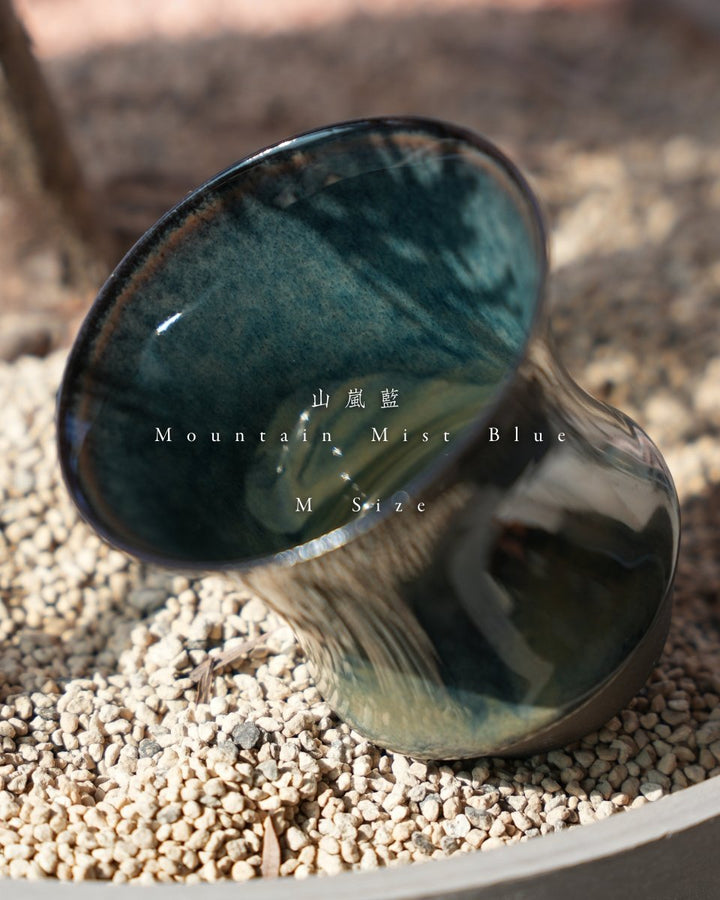
- S Size: approximately 60–65ml, suitable for espresso, small pour-over servings, tea or alcoholic drinks; HK$168.
- M Size: listed at approximately 170g, suitable for medium servings and staged tasting; HK$238.
- L Size: approximately 300–330ml, suitable for a larger everyday drink or brewing directly into the cup; HK$298.
- Alpha: approximately 230ml, designed to balance aroma with everyday use; HK$388.
- Beta: approximately 190ml, designed for more concentrated aroma exploration; HK$458.
If you require dishwasher or microwave use, strong impact resistance, long heat retention or immediate stock, the Sharing Cup range may not be the best fit.
What to know before buying
- Sharing Cup is designed and made by hand in Hong Kong.
- Current glazes include Mountain Mist Blue, Night Blue, Twilight Mountain Purple and Ember Gold Black.
- Glaze, texture, capacity and dimensions may vary slightly between handmade pieces.
- No Sharing Cup is dishwasher-safe, and microwave use is not currently recommended.
- Hand-wash with clean water, a soft sponge and neutral detergent.
- Avoid steel wool, highly abrasive tools and sudden temperature changes.
- These products are currently available for pre-order, with preparation expected to take approximately 30–60 days from the order date.
- Actual timing may vary with order volume, glaze choice and firing results.
For details about black clay, special glazes, firing ranges and the Hong Kong production process, see the separate Sharing Cup craft article; those subjects are not repeated here.
Finally: not which cup is best, but what you want to observe
An ordinary coffee cup can fully meet most everyday needs. An aroma-focused cup becomes meaningful only when you begin noticing the rim, liquid level, position of your nose, and how the same coffee changes across temperatures and cup shapes.
The reason to choose Beta is not that it is best for everyone, but that it turns the question “How close can aroma be brought?” into a cup that can be picked up and used every day.
View the full Coffee Stage Sharing Cup range: S, M, L, Alpha and Beta