

Have you noticed how easy it is to miss a coffee’s aroma while drinking it?
Whether you are drinking cola, eating siu mai and fish balls, or ordering hot-and-sour noodles at Kwai Chung Plaza, the first thing to draw you in is often not taste but aroma. Our sense of taste may be less sensitive than we imagine; smell is what opens the door to the full sensory experience.
That observation became the starting point for Sharing Cup Alpha.
Why Does Aroma Matter More Than Taste?
Sensory-science research suggests that as much as 80% to 90% of what we perceive as “taste” actually comes from smell. This helps explain why food can seem flavourless when a cold blocks the nose.
Scientifically, humans perceive aroma through two pathways:Orthonasal olfaction, which detects external aromas as we breathe in through the nostrils; andRetronasal olfaction, which detects aromas travelling through the throat into the nasal cavity while we eat or drink. The two routes involve different neural processes and together shape our complete perception of flavour.
Coffee has an especially rich aromatic world. A cup of specialty coffee contains more than 800 to 1000 volatile compounds—over four times as many as wine. They include:
- Furans: sweet aromas reminiscent of caramel and butter
- Pyrazines: roasted and nutty notes
- Aldehydes: malt and chocolate notes
- Sulphur compounds: aromas characteristic of freshly brewed coffee
- Phenols: smoky and woody notes
These compounds must evaporate from the liquid’s surface before the nose can detect them. Research using Pearson correlation analysis reported a coefficient of 0.9535 between aroma and a coffee’s overall score, supporting aroma’s central role in quality assessment.
How Is Aroma Assessed in Professional Cupping?
In the SCA (Specialty Coffee Association) cupping process, aroma is scored independently across three stages:
- Dry fragrance: assessing the scent of dry coffee immediately after grinding
- Wet aroma: assessing the aromas held beneath the layer of grounds after water is added
- Breaking the crust: gently stirring three times with a spoon while bringing the nose as close to the cup as possible
Breaking the crust is a key step in cupping. After water is added, foam, oils and coffee grounds form a natural barrier that traps aroma. Breaking that layer releases the accumulated aromas at once, allowing the cupper to assess the coffee’s most prominent aromatic characteristics.
The Q Grader certification examination also includes a dedicated olfactory test that requires candidates to identify 36 common coffee aromas, underlining the importance of aroma recognition in professional assessment.
What Do We Miss When Drinking Coffee Every Day?
The problem is that we rarely smell coffee as deliberately in daily life as we do during cupping.
You might smell the first sip or two, perhaps swirling the cup as you would wine. But few people repeat that throughout the drink. In everyday use, we tend simply to drink rather than bring our nose close to the cup each time.
An ordinary cup also presents a physical limitation. Tilt it far enough towards your mouth and the coffee can spill; tilt it less and your nose remains too far from the liquid to receive as many aroma molecules.
That is the problem we wanted to address.

Can the Shape of a Cup Really Change Flavour Perception?
In 2018, Brazilian neuroscientist Dr Fabiana Carvalho and Oxford University professor Charles Spence published a landmark study in Food Quality and Preference that systematically demonstrated how cup shape can significantly influence the perception of coffee flavour.
The study tested professional baristas and general consumers using three cup shapes—tulip, open and split—and found that:
- A narrower openingcan retain volatile aromatic compounds in the cup’s interior, keeping them there longer and heightening perceived aroma
- A larger liquid surface areaencourages more aroma molecules to evaporate and be released
- A thin rimcan refine the flow of liquid and expose the palate to a broader range of flavour layers
The science behind these findings is the “headspace effect”: volatile aroma molecules collect in the space above the liquid, and the cup’s shape determines how those molecules reach the nose.
Sensory scientist Verônica Belchior has noted that cups with a larger headspace can increase the perceived intensity of coffee aroma. Daniele Ricci, runner-up at the 2023 World Barista Championship, also worked with Dr Carvalho on a purpose-designed cup intended to encourage the retronasal flavour experience.
Tim Wendelboe, the renowned Norwegian roaster and 2004 World Barista Champion, has also said that he immediately noticed the cup shape allowing coffee to express itself differently.
Inspired by an Oxygen Mask
Our idea was simple: if the nose cannot move closer, let the cup surround it.
The inspiration came from an oxygen mask, designed to help a person inhale as much oxygen as possible. Applied to a coffee cup, a rim that naturally surrounds the nose means your nose is already inside the cup each time you drink.
As you sip, the air reaching your nose must first pass through the aroma-filled space inside the cup. There is no need to make a separate effort to smell; aroma molecules travel naturally into the nasal cavity as you breathe.
During development, our tests suggested that the opening in the rim could surround roughly seventy to eighty percent of the nose area. Even when air enters from outside, it first travels through the cup before reaching the nose. Physically, this creates more opportunities to perceive aroma.

The First Concept We Rejected
Before the oxygen-mask idea, we considered a more extreme approach: attaching a miniature fan to the outside of the cup to keep blowing aroma molecules towards the face.
It might work in theory, but it would be cumbersome in practice. The cup would need washing and charging, and drinking from it would be uncomfortable. We quickly rejected the idea.
Sometimes the simplest method is the best. Instead of making the aroma “come out”, we could let the nose “go in”. This also reflects the design idea of first principles: return to the fundamental problem and find the most direct solution.
How It Compares with Other Coffee Cups
There are many excellent coffee-cup brands, each with its own strengths:
Origami, Japan
Made with Mino ware craftsmanship from Gifu Prefecture, Origami’s flavour-cup collection (Aroma / Barrel / Pinot) was developed with world-champion baristas. The Aroma cup highlights bright acidity and fruit; Barrel emphasises sweetness and suits chocolate notes; Pinot balances acidity and sweetness while opening floral aromas. Drawing on wine-glass design, the range uses narrowed openings to concentrate aroma.
Loveramics, Hong Kong
An official cup brand of the WBC / WLAC world coffee competitions, Loveramics fires its ceramics at 1300°C and offers more than 25 glaze colours. The Brewers range includes Floral, Sweet and Nutty tasting cups designed for pour-over, while the classic Egg series is known for its rounded form.
Fellow, United States
The Joey mug pairs a double-walled ceramic body with a copper base, retaining heat while keeping the exterior comfortable to hold. Sometimes described as “the tuxedo of coffee”, its San Francisco design reflects a modern, minimal aesthetic.
AVENSI Professional Tasting Cups
Developed by ICOSA Brewhouse, AVENSI uses an ultra-thin rim that is 60% thinner than that of an ordinary coffee cup, intended to maximise the speed and volume of coffee flowing onto the tongue. Its design draws on wine-glass science and focuses on the sensory experience.
What Makes Sharing Cup Alpha Different
Most of these excellent cups concentrate aroma through a narrower opening or refine mouthfeel through rim thickness. Alpha approaches the question from another direction:bringing the nose directly into the cup’s interior.
With a narrow aroma cup, the nose soon meets the rim as the cup tilts, while the small opening can allow outside air to mix in more readily. Wine and champagne glasses suit drinks taken in small, slow sips, with time between them to swirl and smell. Coffee has a different rhythm: a pour-over may be finished in 15 to 20 minutes, leaving fewer moments to stop and smell deliberately.
Alpha combines the surface-area advantage of a wide cup with an opening in the rim that lets the nose enter the cup naturally, helping aroma become part of the ordinary drinking motion.


The Challenge of Making It
To be candid, producing Alpha has been far more difficult than we expected.
Each Sharing Cup must be fired twice: first as bisque ware and then again after glazing. Every clay and glaze has its own shrinkage rate. The clay may shrink by 10%, rising to 10% to 12% after glazing. This shrinkage creates tension during firing.
Alpha’s rim opening forms a flowing curve, making this area particularly vulnerable. As the material contracts at high firing temperatures, the opening experiences far greater stress than an ordinary rim and is much more likely to break.
We tested different glaze combinations:
- Night Blue: we fired around 30 cups and every one broke, including the glaze surface
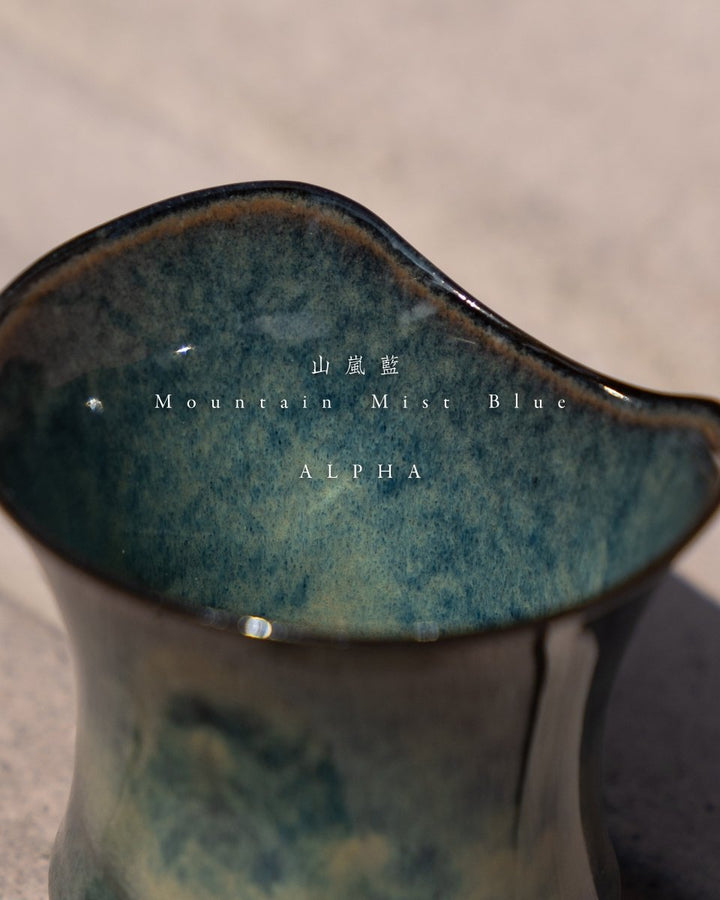
- Mountain Mist Blue with black clay: the most stable combination so far
That is why Alpha is currently available only in Mountain Mist Blue. It is not that we do not want other colours; we are still looking for a technically workable solution.
The curve of the opening presents another challenge. Ceramics deform during firing, and the deformation of this flowing opening is difficult to control. Not every cup reaches the intended curve. It is a little like yield in semiconductor production: even with the same process, not every piece passes quality inspection.
The Distinctive Value of Handmade Ceramics
Unlike mass-produced ceramics, the central value of handmade work lies in itsindividuality: every piece is unique and carries the ceramicist’s ideas and skill.
A handmade cup passes through many stages: forming, trimming, glazing and firing. Variations in colour and texture cannot be duplicated, while changes in the kiln create an unpredictable beauty. That is why every Alpha differs slightly in its details. These differences are not defects; they are evidence of the making process.
A handmade cup may cost as much as several drinks at a café, but it can be used for years and accompany coffee every day. More importantly, it carries a story, considered choices and the record of many failed attempts.
A Candid Note on Who It Suits
Some people have asked whether this cup suits everyone.
We should be candid: if you have a fuller face, the opening in the rim may not fit as comfortably. It follows the contours around an average mouth, so fuller tissue around the lips may meet the edge of the opening.
This is not a judgement; it is a physical limitation. We hope to try a version with a larger opening in the future, once the current production challenges have been resolved.
Why Is It Limited, and Why Is the Price Higher?
Because of these production challenges, Alpha is currently released in limited quantities:
- Limited quantity: 200 cups
- Estimated yield: around 10%—meaning that firing 200 cups may produce only about 20 that pass
This is also why Alpha costs more. The aim is not simply to charge a higher price: production costs and failure rates are genuinely high. Behind every successful Alpha may be nine others that did not pass quality inspection.
If we can improve the yield, we will consider making Alpha regularly available. Until then, each finished cup emerges from a process with many unsuccessful pieces.
Design Inspire 2025: Find Us Here
Sharing Cup Alpha is exhibiting at Design Inspire 2025 .
Organised by the Hong Kong Trade Development Council, Design Inspire is an international exhibition for creativity and design. In 2025, it runs from December 3 to 6 at the Hong Kong Convention and Exhibition Centre, bringing together participants from 14 countries and regions and over 260 design brands. This year’s theme is “Where Connections Spark Inspiration”, highlighting the relationship between design and everyday life.
Its main areas include BOTTEGA HONG KONG, curated by designer Alan Chan; Maison&Objet Intérieurs Hong Kong 2025, presented by the Paris design authority; and Design Factory, which focuses on sustainable design and material innovation.
Showing Alpha on this platform is an important milestone for us. It recognises our idea of bringing sensory science into an everyday object and gives us an opportunity to exchange ideas with design enthusiasts from around the world.
Related listing for this product on the event website:https://designinspire.hktdc.com/en/directory/exh/coffee-stage


Why Might You Want an Alpha?
Alpha may suit you if:
Aroma matters to you
You know how many aromatic layers a good coffee can offer—from flowers and fruit to nuts and caramel—and want to experience them in everyday drinking, not only during cupping.
You already have good coffee and brewing equipment
You have invested in quality beans, a precise grinder and a carefully chosen pour-over kettle, but feel that the cup may still offer room for improvement. You believe the right tool can help coffee express itself more fully.
You are interested in design and craft
You value objects with a story and considered thinking behind them, rather than an ordinary container. You want to understand the designer’s intention and support handmade craft.
You are open to a new experience
Drinking from Alpha may take a little adjustment because the opening feels different from an ordinary rim. You are willing to explore what this design might bring to the experience.
Specifications
- Capacity: approximately 230ml
- Material: black-clay ceramic
- Glaze: Mountain Mist Blue
- Suggested brew: 15g of coffee at approximately a 1:15 ratio
- Origin: designed and handmade in Hong Kong
- Limited edition: 200 cups
A Final Note
Sharing Cup Alpha is not intended to replace the cups you already own, nor to suggest that other cups are inferior. There are many excellent coffee-cup brands, each with its own design ideas and strengths.
Alpha is simply our attempt to see whether one straightforward design could bring more aroma into everyday coffee. The idea grew from our own observations while drinking coffee, followed by repeated tests and failures before reaching this version.
Everyone perceives aroma differently and has different drinking habits. This cup may not suit everyone, but if it interests you, you are welcome to learn more.
If you have any questions, leave a comment or send us a message.
Coffee Stage Website:mycoffeestage.com
Instagram:@5lungcoffee / @coffee_stage_5lung
YouTube:Designed by Alpha
Sharing Cup : https://mycoffeestage.com/products/coffee-stage-sharing-cup